Home 01
Parliament 05
Contact 17
Mr. Digant Sharma +91 9769999960 im@digantsharma.com

Public life / Tribal affairs / Parliament

Jual Oram

Union Minister of Tribal AffairsMember of Parliament (Lok Sabha) for Sundargarh, Odisha

This website documents his public life, from Sundargarh district in Odisha to six terms in the Lok Sabha and three tenures in charge of the Ministry of Tribal Affairs. It is written from parliamentary, ministerial and other official records.

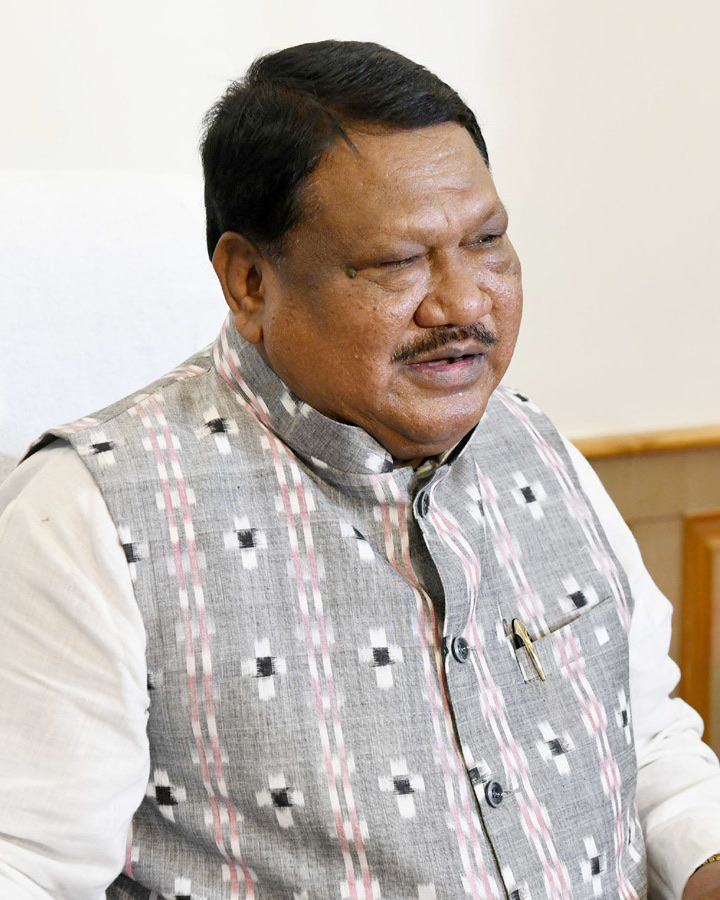
Portrait of Jual Oram, seated, wearing a grey ikat-patterned waistcoat over a white kurta
H-01Jual Oram, Union Minister of Tribal Affairs.
01 — Public life

A public life shaped across Odisha, Parliament and national tribal-development policy

Six places anchor the record: a village in Sundargarh district, the industrial town where he trained, the Assembly seat he first won, the Lok Sabha constituency he has represented since 1998, and two institutions in New Delhi.

Schematic map of Jual Oram's public life A schematic, not-to-scale map. Four numbered points in Sundargarh district, Odisha (Kendudihi, Rourkela, Bonai, Sundargarh) are joined by a route that leads north-west to two points in New Delhi: Parliament and the Ministry of Tribal Affairs. The numbered legend beside the map lists each point. 1 2 3 4 5 6 SUNDARGARH DISTRICT · ODISHA NEW DELHI Kendudihi Rourkela Bonai Sundargarh Parliament Ministry
Schematic; positions approximate and not to scale. North is up.
  1. 1
    Kendudihi, Lahunipara1961

    Birthplace, in Sundargarh district, Odisha.

  2. 2
    Rourkela1982

    Diploma in Electrical Engineering, U.G.I.E. Rourkela.

  3. 3
    Bonai1990–1998

    Two terms in the Odisha Legislative Assembly, first elected in 1990.

  4. 4
    Sundargarh (ST) constituency1998–

    Elected to the Lok Sabha in 1998, 1999, 2004, 2014, 2019 and 2024.

  5. 5
    Parliament, New Delhi6 terms

    Member of the 12th, 13th, 14th, 16th, 17th and 18th Lok Sabha.

  6. 6
    Ministry of Tribal Affairs1999 · 2014 · 2024

    Its first Union Minister in 1999; again from 2014 to 2019; and since June 2024.

ConstituencySundargarh (ST), OdishaLok Sabha seat reserved for Scheduled Tribes
HouseLok Sabha18th Lok Sabha; sixth term, since 9 June 2024
Ministerial roleUnion Cabinet Minister of Tribal AffairsSince 9 June 2024; third tenure
Technical educationDiploma in Electrical EngineeringU.G.I.E., Rourkela
Born22 March 1961Kendudihi, Sundargarh district

Source: Lok Sabha member record, sansad.in (opens in a new tab); PRS Legislative Research, prsindia.org (opens in a new tab). Checked 19 September 2026.

Chronology

Career chronology, 1961 to 2026

Twelve dated stations along the record. Scroll the route sideways, or use the arrow buttons.

  1. 1961

    Born in Kendudihi

    Born on 22 March 1961 at Kendudihi, Lahunipara, in Sundargarh district, Odisha.

  2. 1982

    Technical diploma

    Diploma in Electrical Engineering from U.G.I.E., Rourkela. He also worked for six years with BHEL.

  3. 1989

    Joins the BJP

    Joins the Bharatiya Janata Party. Before this he had worked in industry and as a trade-union organiser.

  4. 1990

    Odisha Assembly

    Elected to the Odisha Legislative Assembly; re-elected in 1995. Member until 1998.

  5. 1998

    Lok Sabha

    First elected to the Lok Sabha from Sundargarh (12th Lok Sabha).

  6. 1999

    First Minister of Tribal Affairs

    Re-elected; sworn in on 13 October 1999 as the first Union Minister of the new Ministry.

  7. 2004

    Third term

    Re-elected to the 14th Lok Sabha. The first ministerial tenure ends in May 2004.

  8. 2009

    Party organisation

    Not returned to the 15th Lok Sabha. Serves as BJP Odisha State President (2009–11).

  9. 2014

    Second ministerial tenure

    Returns to the Lok Sabha; Union Cabinet Minister of Tribal Affairs, May 2014 to May 2019.

  10. 2019

    Defence committee

    Re-elected; Chairperson of the Standing Committee on Defence from 13 September 2019.

  11. 2024

    Sixth term, third tenure

    Re-elected; sworn in on 9 June 2024 and assumes charge of the Ministry on 14 June 2024.

  12. 2026

    Current role

    Union Cabinet Minister of Tribal Affairs and Member of Parliament for Sundargarh.

Sources: Lok Sabha member record; PIB releases of 14 June 2024 (PRID 2025305 (opens in a new tab)). Ministerial dates for 2014–2019 are given to the month; the Lok Sabha record lists 27 May 2014 to 25 May 2019.

02 — Parliament

Six Lok Sabha terms from one constituency

Sundargarh has returned him to the Lok Sabha six times since 1998. The band below shows each term, the three ministerial tenures, and his chairmanship of the Standing Committee on Defence.

  • Lok Sabha terms: 12th (1998–1999), 13th (1999–2004), 14th (2004–2009), 16th (2014–2019), 17th (2019–2024), 18th (2024–present). Not a member of the 15th Lok Sabha (2009–2014).
  • Union Cabinet Minister of Tribal Affairs: 13 October 1999 – May 2004; May 2014 – May 2019; 9 June 2024 – present.
  • Chairperson, Standing Committee on Defence: from 13 September 2019 during the 17th Lok Sabha.

Open the parliamentary archive

03 — Tribal development

How the system is built: mandate, instruments, delivery

The Ministry of Tribal Affairs is the nodal ministry for policy planning and coordination of programmes for Scheduled Tribes. Most programmes are delivered with State Governments, other Union ministries and community institutions, so outcomes are shared, not individual.

A Mandate

  • Constitution Articles 244 and 342; the Fifth and Sixth Schedules
  • Allocation of Business Development of STs, Scheduled Areas, tribal welfare planning
  • Forest Rights Act, 2006 The Ministry is the nodal agency

B Instruments

  • EMRS Residential schools, Classes VI–XII
  • PMJVM and Van Dhan Forest produce, value addition, markets
  • DAJGUA Village-level saturation of infrastructure gaps
  • PM-JANMAN Focused on 75 PVTGs
  • Adi Karmayogi Responsive-governance cadre

C Delivery

  • Societies and federations NESTS, TRIFED, NSTFDC
  • Union ministries 17 line ministries under DAJGUA
  • States and districts Tribal welfare departments, ITDAs and ITDPs
  • Communities Gram Sabhas, self-help groups, local volunteers

Explore the tribal development system

Reading these figures. They describe national programmes run by the Ministry with States, federations and communities. They are official programme data, not personal achievements.